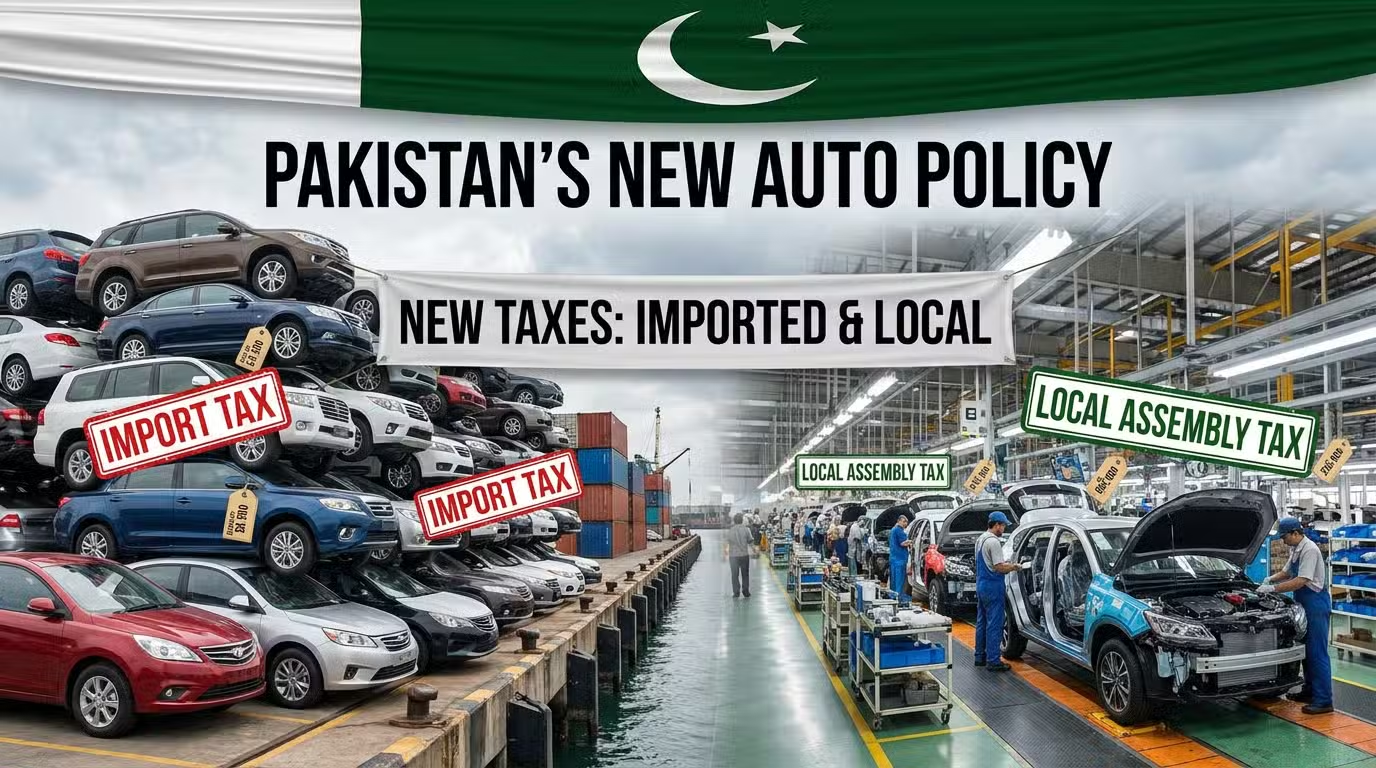


The New Car Levy Rs 188 Billion Pakistan five-year revenue projection has officially been approved by Prime Minister Shehbaz Sharif under the draft automotive policy. According to revenue estimates prepared by the Ministry of Industries and Production in coordination with the Federal Board of Revenue (FBR), the federal government aims to generate a total of Rs. 188.58 billion through the newly introduced Automotive Development Levy on locally assembled, manufactured, and imported internal combustion engine (ICE) vehicles over the next five fiscal years.
The proposed levy serves as a strategic non-tax revenue generation mechanism designed to regulate traditional combustion engine automobiles, promote domestic industrial localization, and create dedicated funding streams for national economic development.
Year-by-Year Financial Projections and Market Framework
According to official policy projections, revenue generated through the New Car Levy Rs 188 Billion Pakistan strategy is expected to maintain a steady and predictable trajectory throughout the five-year implementation window:
+-----------------------------------------------------------------------------------+
|               Automotive Development Levy 5-Year Revenue Roadmap                  |
+--------------------------+--------------------------------------------------------+
| Fiscal Year 2026–27      | Rs. 37.71 Billion                                      |
| Fiscal Year 2027–28      | Rs. 38.46 Billion (Peak Revenue Year)                  |
| Fiscal Year 2028–29      | Rs. 38.29 Billion                                      |
| Fiscal Year 2029–30      | Rs. 37.30 Billion                                      |
| Fiscal Year 2030–31      | Rs. 36.83 Billion                                      |
| Cumulative 5-Year Total  | Rs. 188.58 Billion                                     |
+--------------------------+--------------------------------------------------------+
Key Financial Insights
-
Peak Collection Window: Annual revenue collection under the New Car Levy Rs 188 Billion Pakistan initiative is projected to reach its highest point during the 2027–28 fiscal year at Rs. 38.46 billion.
-
Stable Inflow Base: Government estimates indicate that annual returns from locally assembled and manufactured passenger vehicles will remain relatively stable across the five years, fluctuating between Rs. 36.83 billion and Rs. 38.46 billion.
-
Macroeconomic Variables: Policy officials emphasize that final collected amounts will ultimately depend on actual market implementation, specific calculation methodologies, total vehicle import volumes, and domestic buyer demand.
Tiered Tax Structure by Engine Capacity and Vehicle Type
To protect low-income consumers and small businesses while ensuring equitable taxation on high-value luxury automobiles, the draft policy establishes clear slab rates based on engine displacement (cc) and operational classification:
+----------------------------------+-----------------------+------------------------+
| Engine Displacement / Vehicle    | Applicable Levy Rate  | Market Impact          |
+----------------------------------+-----------------------+------------------------+
| Cars Below 1,000cc               | 0% (Fully Exempt)     | Protects Budget Cars   |
| Cars 1,001cc to 2,000cc          | 2% Levy Rate          | Mid-Size Sedans & CUVs |
| Cars Above 2,000cc               | 10% Levy Rate         | High-End Luxury SUVs   |
| Motorcycles & 3-Wheelers         | 0% (Fully Exempt)     | Protects Mass Transit  |
| Agricultural Tractors            | 0% (Fully Exempt)     | Protects Farming Sector|
| Trucks, Buses, LCVs, Prime Movers| 2% Levy Rate          | Logistics & Transport  |
+----------------------------------+-----------------------+------------------------+
Breakdown of Slabs and Exemptions
-
Budget Hatchback Shield (Under 1,000cc): Small passenger vehicles with engines below 1,000cc carry a 0% levy rate, shielding budget-conscious buyers, entry-level hatchbacks, and local mass-market models from immediate price inflation.
-
Mid-Range Segment (1,001cc to 2,000cc): Popular mid-size sedans, compact crossovers, and family vehicles carry a 2% automotive levy, adding a modest duty to standard consumer automobiles.
-
Luxury SUV Category (Above 2,000cc): High-displacement passenger cars, imported luxury SUVs, and executive sedans above 2,000cc face a steep 10% levy rate, ensuring higher tax contributions from premium vehicle owners.
-
Commercial and Agriculture Protection: Two-wheelers (motorcycles), three-wheelers (rickshaws), and agricultural tractors are completely exempted from the levy to safeguard rural livelihoods and daily commuting costs. Light commercial vehicles (LCVs), buses, trucks, and prime movers carry a minor 2% rate to minimize freight cost escalation.
Economic Rationale and Automotive Market Impact
The New Car Levy Rs 188 Billion Pakistan policy aligns with broader federal fiscal reforms intended to address budget deficits while steering the automotive industry toward technological modernization. By imposing higher rates on larger internal combustion engines while maintaining zero rates on small cars and electric vehicles, the government seeks to balance non-tax revenue generation with sustainable consumer mobility.
While auto assemblers and industry analysts are closely evaluating the policy’s potential effect on vehicle retail prices, government officials remain confident that the structured slabs will maintain overall market stability and encourage localized manufacturing.