

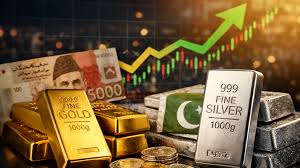
Gold and silver prices in Pakistan have recently surged to historic record highs, leaving investors, consumers, and traders closely watching bullion market trends. This jump in precious metal rates reflects a complex interplay of global and local economic forces — from global safe-haven demand and geopolitical uncertainty to currency dynamics and rising investment interest.
Gold and silver have long been considered hedges against inflation and currency depreciation, but the latest rally underscores just how significant these traditional assets remain in uncertain economic times.
Recent Price Movements – Local Market Overview
In Pakistan’s bullion market:
• Gold prices soared to an all-time high, with 24-karat gold per tola jumping to around Rs532,062 — a significant single-day increase of roughly Rs10,900.
• Prices for 10 grams of 24-karat gold also rose sharply, while 22-karat gold climbed considerably as well. 
• Silver also hit record levels, with 24-karat silver per tola increasing to approximately Rs11,428 and 10 grams nearing Rs9,797.
These levels represent some of the highest points ever recorded in Pakistan’s bullion trading history and mirror broader global trends.
What’s Driving the Surge?
1. Global Safe-Haven Demand
Worldwide uncertainty — particularly related to geopolitical tensions, trade disputes, and fluctuating currency markets — has pushed investors toward safe-haven assets such as gold and silver. Historically, when financial markets become turbulent or inflation fears rise, precious metals become attractive stores of value. This has markedly influenced bullion demand both internationally and within Pakistan.
2. International Market Rally
Record and near-record gold prices in Pakistan reflect massive increases in global bullion prices. International gold benchmarks have been climbing toward and beyond unprecedented levels, with prices rising due to demand from central banks, investors, and speculators alike.
3. Currency and Economic Concerns
As major currencies fluctuate against the U.S. dollar and emerging-market currencies remain volatile, gold and silver often provide a hedge — a way for investors to protect their holdings from depreciation and devaluation. In markets like Pakistan, where inflationary pressures and exchange rate shifts can be pronounced, precious metals become especially attractive alternatives.
Local vs. Global Trends — A Comparison
• Gold Price in Pakistan (Local):
• Gold per tola reached a record around Rs521,162 – Rs532,062 in recent rallies.
• 10-gram gold also hit historic highs above Rs440,000+.
These figures reflect sustained upward pressure in the domestic market.
• Gold Price Globally:
• International gold prices have surged past $5,000 per ounce (approx. $5,089–$5,100/oz), driven by safe-haven buying and geopolitical tensions.
• Silver prices globally climbed above $100 per ounce, a historic milestone.
This global rally underpins local increases.
Silver in Pakistan (Local):
• Silver per tola rose to all-time highs around Rs10,801+, reflecting intense local demand.
• 10-gram silver also surged into record territory.
Domestic prices often include premiums due to supply and market factors.
• Silver Globally:
• Silver prices broke above $100/oz as investors flocked to precious metals, marking a rare and strong rally.
• Global silver has seen sharp percentage gains alongside gold.
• Key Local Drivers:
• Exchange rate volatility
• High domestic demand for jewellery and investment
• Traditional preference for metals as wealth preservation
• Key Global Drivers:
• Safe-haven demand in turbulent financial markets
• Central bank gold purchases
• Weaker U.S. dollar and monetary policy shifts
• Market Impact (Local):
• Jewellery and bridal purchases became more expensive
• Some buyers delay purchases locking in price expectations
• Market Impact (Global):
• Institutional investors increased exposure
• ETFs and futures markets saw elevated trading volumes
Impact on Consumers and Investors
For Everyday Consumers:
• Higher gold and silver prices make jewellery purchases costlier.
• Traditional cultural demand — such as weddings and seasonal buying — becomes more expensive.
• Some households may delay purchases, expecting potential future shifts.
For Investors:
• Bullion holders benefit from capital appreciation.
• Many investors view gold and silver as safe stores of wealth during market volatility.
• Rising prices may lead to increased trading and speculation.
Historical Context
Gold and silver have a lonious Metals in Pakistang-standing role in Pakistan’s economy:
• These metals are traditional hedges against inflation.
• Cultural and festival demand — such as weddings — regularly influences bullion markets.
• Over the past year, prices have steadily climbed due to global and local catalysts. 
For example, historical patterns show consistent upward movement in gold prices aligning with global peaks, underscoring how integrated the Pakistani bullion market is with global benchmarks.
Why Investors Still Choose Gold and Silver
Investors often prefer gold and silver for several reasons:
• Inflation hedge: Precious metals often retain value better than currencies during inflationary periods.
• Safe haven: During geopolitical unrest or financial uncertainty, metals shine as stable assets.
• Portfolio diversification: Adding gold and silver can reduce risk in mixed investment portfolios.
These factors explain why demand remains robust even as prices climb to new highs.
FAQs — What Pakistanis Should Know
Q1: Why are gold and silver prices rising so sharply right now?
A: Prices are increasing due to a combination of global safe-haven demand, strong international price benchmarks, and local currency and economic pressures.
Q2: Should I invest in bullion now?
A: Investment decisions depend on individual financial goals. Precious metals can provide diversification, but it’s wise to consider market volatility and consult financial advisors.
Q3: Do higher gold prices affect jewellery demand in Pakistan?
A: Yes, historically rising bullion prices can dampen short-term jewellery purchases but may boost long-term investment interest.
Q4: Are silver prices following gold trends?
A: Often, yes. While silver has more industrial demand, its price movements frequently correlate with gold during market surges.
Conclusion
The recent surge in prices — where gold and silver prices surged to record highs in Pakistan — reflects deep global and local economic currents. Investors and consumers alike are watching closely as both metals continue to climb. While this trend can benefit bullion holders, it also poses challenges for everyday jewellery buyers and those hoping for price stability.
Whether you view precious metals as a traditional investment or a hedge against uncertainty, understanding the forces behind this record surge is key to making informed financial choices in Pakistan’s evolving economic landscape.