


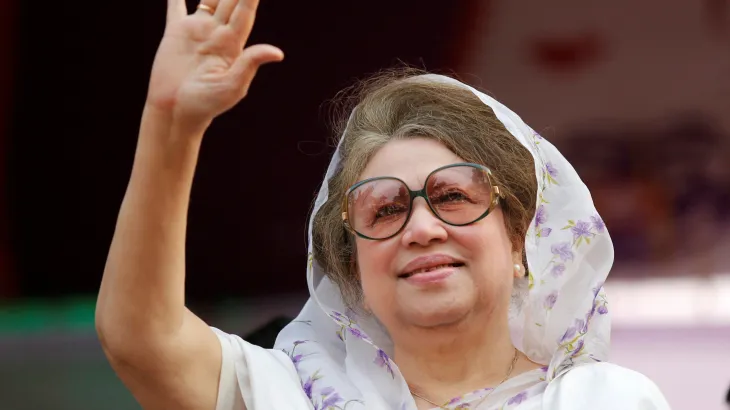
The end of a defining political chapter and legacy of democratic resilience
DHAKA — Begum Khaleda Zia, Bangladesh’s first female prime minister and one of the most influential political leaders in the nation’s history, has died at the age of 80 after a prolonged illness, her party announced on December 30, 2025. Her passing marks the end of a historic era in Bangladeshi politics and has prompted national mourning across the country.
🕊️ A Storied Life: From Political Widow to National Leader
Born in then British India, Khaleda Zia entered politics after the assassination of her husband, President Ziaur Rahman, who founded the Bangladesh Nationalist Party (BNP). Her rise was shaped by personal tragedy and national upheaval, ultimately leading her to become Bangladesh’s first woman prime minister in 1991 — a milestone not just in the country’s history, but across Muslim-majority democracies globally.
In a nation where political leadership has long been dominated by men, her ascent broke barriers and reshaped expectations about women’s roles in governance. This landmark achievement placed her alongside pioneers like Benazir Bhutto of Pakistan, as one of the few female leaders in South Asia to lead a democratic government.
Two Terms and an Enduring Influence
First Term (1991–1996): Restoring Democracy
Khaleda Zia’s first term came after Bangladesh’s return to parliamentary democracy. Her government shifted the country from a presidential system to one where executive power rested with the prime minister, restoring democratic norms and reinvigorating civil institutions. Her policies emphasized foreign investment and expanded access to primary education, particularly for girls — demonstrative of her focus on social development.
Second Term (2001–2006): Progress and Controversy
Her second tenure was marked by economic initiatives, but also serious challenges. Rising militancy and a 2004 grenade attack at a political rally haunted her legacy. Although not directly implicated, her government’s inability to prevent violence drew criticism. Additionally, allegations of corruption later dogged her reputation and led to legal battles in subsequent years.
⚔️ The “Battling Begums”: Khaleda Zia vs. Sheikh Hasina
A central theme of Khaleda Zia’s political life was her intense rivalry with Sheikh Hasina, leader of the rival Awami League. Their feud shaped Bangladesh’s political landscape for decades — so much so that commentators often referred to them as the “battling begums.”
Unlike Hasina’s more assertive public persona, Zia was described as measured and traditional, yet resolute in defense of her party’s vision. Their contrasting leadership styles eclipsed many national debates, turning elections into personal contests that tested the resilience of Bangladesh’s democracy.
🩺 Final Years: Illness, Battles, and Return
In her later years, Khaleda Zia suffered from multiple health issues including advanced cirrhosis of the liver, arthritis, diabetes, and heart complications — conditions that ultimately led to her death after treatment at Evercare Hospital in Dhaka.
For many years her requests to seek medical care abroad were denied under political tension. Only after the ousting of Hasina in 2024 was she permitted to travel overseas for treatment, returning to Bangladesh earlier in 2025.
Her son, Tarique Rahman, returned from nearly 17 years in exile and took an increasingly visible role in the BNP. He is widely expected to carry forward his mother’s political vision in the upcoming 2026 general election.
🌍 How the World Responded
Global leaders and regional neighbours acknowledged her death with tributes reflecting her complex and impactful legacy:
• Countries like Pakistan and India acknowledged her diplomatic engagements and contributions to regional relations.
• International observers commented on her role in championing democratic governance amid adversity.
In Bangladesh, the interim government declared three days of state mourning, underscoring her stature in the nation’s collective memory.
🧠 Insights and Legacy
A Trailblazer for Women in Politics
Khaleda Zia’s career demonstrated that women could rise to the highest levels of political leadership in South Asia. Her leadership inspired a generation of female politicians across Bangladesh and beyond.
A Polarising But Pivotal Figure
Her legacy is multifaceted — celebrated for her role in restoring democratic governance and expanding social access, yet controversial for periods marked by political confrontations and corruption allegations.
A Testament to Perseverance
Despite imprisonment, health struggles, and political exile, her voice remained a constant in Bangladesh’s national dialogue. Her resilience mirrored wider societal aspirations toward democratic resilience and gender equality.
🔍 Frequently Asked Questions (FAQs)
Q1: What made Khaleda Zia’s leadership historic?
A: Khaleda Zia became Bangladesh’s first female prime minister in 1991, breaking gender barriers and joining a select group of female leaders in Muslim-majority democracies.
Q2: What were her major accomplishments as prime minister?
A: She restored parliamentary democracy, expanded education access for girls, and pursued economic reforms that opened Bangladesh to foreign investment.
Q3: What health issues led to her death?
A: Doctors reported several conditions including advanced liver cirrhosis, diabetes, and heart complications contributed to her declining health and eventual death.
Q4: Who will lead the BNP now?
A: Her elder son, Tarique Rahman, is poised to lead the Bangladesh Nationalist Party and stands as a potential candidate in the 2026 election.
Q5: How long did she serve as prime minister?
A: Khaleda Zia served two terms: 1991–1996 and 2001–2006.
📝 Conclusion
Khaleda Zia’s passing at age 80 closes a monumental chapter in Bangladesh’s journey toward democratic governance. A trailblazer, a fierce strategist, and a pillar of her nation’s political evolution, her life was intertwined with Bangladesh’s triumphs and trials. Her legacy — complex, contested, and deeply felt — will influence discussions on women’s leadership, democracy, and national identity for years to come.


